
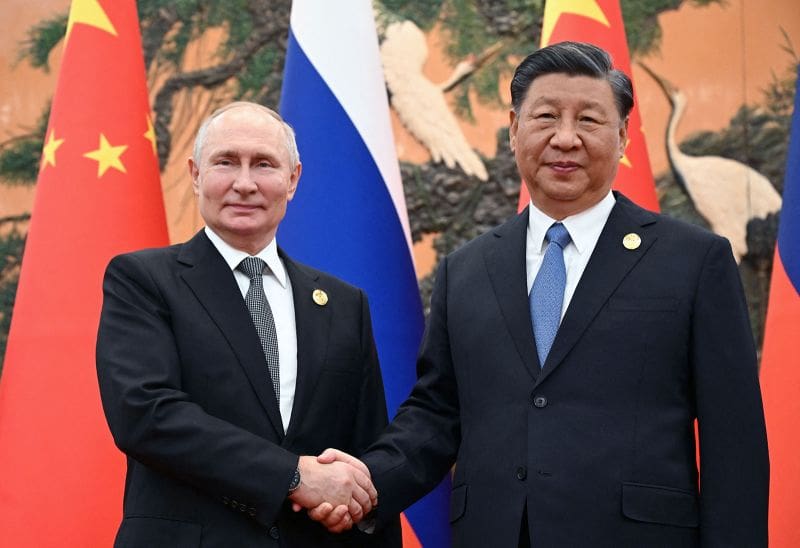
Russian intelligence considers China an espionage threat. Publicly, the Kremlin calls Beijing it’s closest strategic partner. This sits at the center of the modern China-Russia relationship. For more than two decades, Russian authorities have accused scientists, engineers, and defense insiders of providing sensitive military technology to the Chinese. Russian arms companies have also documented hundreds of cases of unauthorized copying, while state-linked Chinese hackers have targeted networks connected to the Russian military industrial complex. Moscow has reasons to remain silent on the issue. China is no longer just a customer for Russian arms. It has become an important supplier of the components, tools, and sanctioned technology that Russia needs to sustain it’s own military production.
Beneath the choreography of the Sino-Russian “no-limits partnership” lies one of the more consequential and least publicly acknowledged intelligence contests of the twenty-first century: a sustained, multi-decade campaign by China’s intelligence services and state-linked cyber units to acquire Russian military and dual-use technology, often from the very partner Beijing calls its principal strategic counterweight to the West.
This brief traces that campaign from its Cold War-era roots through the post-Soviet arms bazaar of the 1990s, the treason prosecutions of Russian scientists that have run almost continuously since 2004, and the cyber intrusions attributed to Chinese state-linked actors that surfaced in 2023–25. It assesses how the resulting transfer of know-how, licit and illicit, helped seed China’s indigenous military-industrial base, from the J-11 fighter to the WS-15 engine now flying in the J-20. Finally, it examines the paradox defining the relationship in 2026: even as Russian counterintelligence privately designates China a threat, Moscow’s deepening economic and technological dependence on Beijing has left it with almost no leverage to act on that assessment publicly.

1. Origins: From Fraternal Aid to Reverse Engineering
The Sino-Russian technology relationship began not as espionage but as alliance. After China entered the Korean War in 1950 and suffered devastating losses against better-equipped UN forces, Moscow agreed in 1951 to re-arm and re-train the People’s Liberation Army wholesale, transferring aircraft, artillery and industrial know-how that formed the skeleton of China’s first defense-industrial base.
That fraternal phase ended with the Sino-Soviet split of the 1960s, but the underlying pattern, China as net technology recipient, Russia as supplier and patron, re-emerged after the Soviet collapse. Beijing became Moscow’s largest arms customer through the 1990s and 2000s, and it was within that legitimate commercial relationship that the first documented thefts occurred. In 2004, three separate Russian court cases convicted seven individuals of passing classified aviation and satellite data to Chinese intelligence. A year later, five scientists from the state rocket enterprise TsNIIMash-Export were arrested for selling missile and space technology to a Chinese import-export firm, a case human-rights groups later criticized as politically overreached, but one that established a template Russian counterintelligence would repeat for the next two decades.
The commercial arms relationship itself became the primary vector. China’s purchase of Su-27 fighters and S-300 air-defense systems in the 1990s was followed, within roughly a decade, by the debut of visually and functionally near-identical Chinese systems, the J-11 fighter and the HQ-9 missile, marketed as indigenous designs. Russian industry executives use the term “Shanzhai,” borrowed from China’s own counterfeit-goods culture, to describe the practice.
2. The Reverse-Engineering Ledger
By 2019, Rostec, Russia’s state defense conglomerate, broke with decades of diplomatic reticence to put a number on the practice. Yevgeny Livadny, the corporation’s chief of intellectual-property projects, disclosed that Russian firms had documented more than 500 cases of unauthorized copying of Russian military hardware over the preceding 17 years, naming China specifically for cloning aircraft engines, Sukhoi airframes, carrier-borne jets, air-defense systems, portable air-defense missiles and analogues of the Pantsir medium-range system.
Unauthorized copying of our equipment abroad is a huge problem. China alone has copied aircraft engines, Sukhoi planes, deck jets, air defense systems, portable air defense missiles, and analogues of the Pantsir medium-range surface-to-air systems.
, Yevgeny Livadny, Rostec, December 2019
Rostec’s own officials acknowledged the practical limits of any response: because Russia has not registered patents for most of its weapons systems abroad, there is little legal basis to contest the copying in foreign courts, even when it is caught red-handed by Russian specialists working on-site. In response, Moscow adjusted its commercial practices, requiring bulk purchases rather than small sample orders that invite reverse engineering, inserting anti-copying clauses into contracts, and in some cases withholding the underlying technical documentation and selling only finished, “black-boxed” products rather than transferring manufacturing know-how.
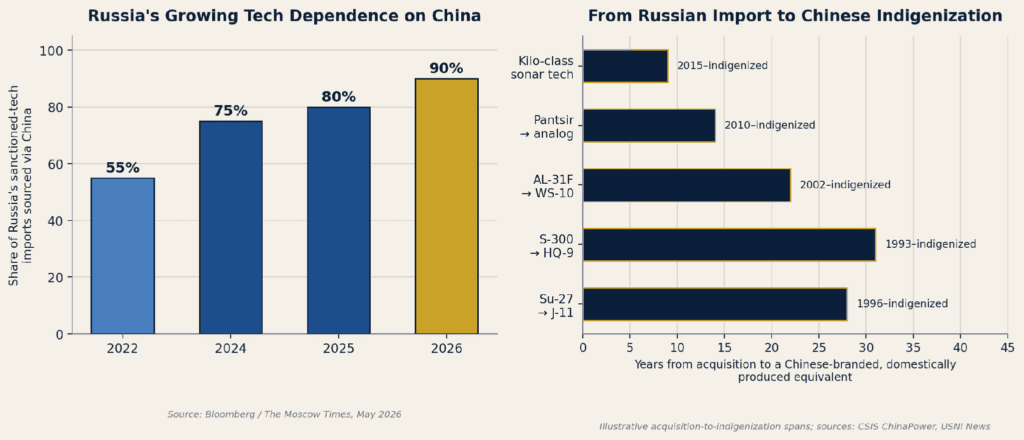
Left: Russia’s climbing dependence on China for sanctioned technology imports. Right: illustrative timelines from Russian-origin platforms to Chinese indigenized equivalents.
Aerospace has been the most heavily targeted domain. Between 2021 and 2023 alone, Russian authorities documented four further incidents of researchers passing sensitive aerospace and laser-technology materials to Chinese contacts, on top of the 2004 and 2005 cases. The throughline across two decades is consistent: China acquires a system commercially or through licensed co-production, extracts the underlying engineering data through a mix of legitimate reverse engineering and clandestine collection, and within roughly one to two decades fields a domestically branded equivalent, after which Chinese orders for the original Russian system decline sharply.
3. The Scientist Prosecutions: A Two-Decade Pattern
Nowhere is the human cost of this campaign more visible than in Russia’s long-running series of treason prosecutions against its own hypersonics and aerospace scientists. What Russian human-rights defenders and independent outlets have called “the hypersonic scientists case” is, by some tallies, the largest criminal prosecution of researchers in modern Russian history, spanning eleven years, ensnaring eleven physicists, killing three of them during investigation, and effectively issuing prison terms incompatible with life to five others.
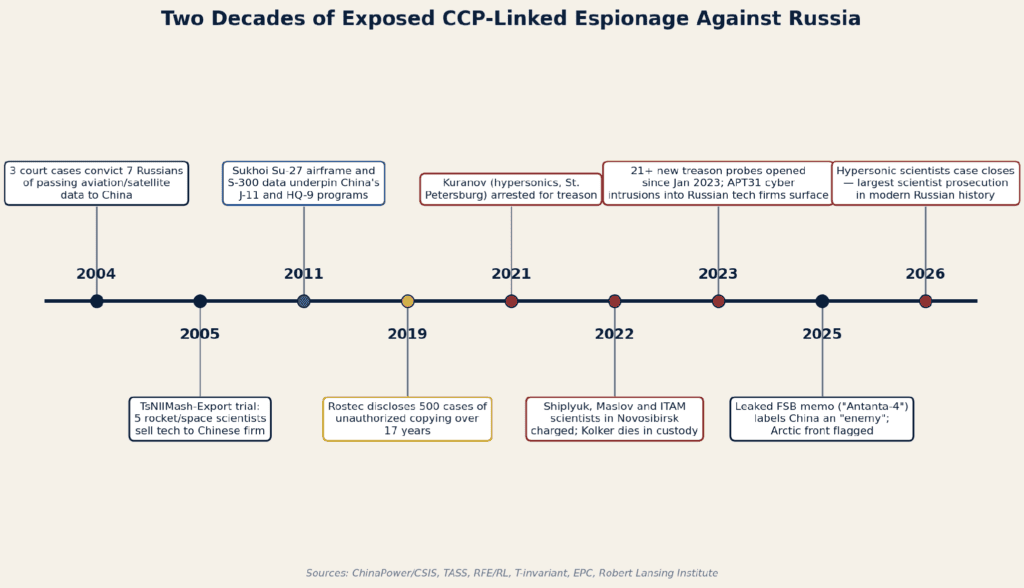
Major publicly exposed espionage and treason cases linking Chinese intelligence collection to Russian military-technical secrets, 2004–2026.
The pattern began in earnest with Vladimir Lapygin, a 46-year veteran of the TsNIIMash rocket institute who had worked on every Soviet and Russian launch vehicle and intercontinental ballistic missile program since 1970. While in pre-trial detention, Lapygin authored a 32-page account titled “How I Became a Chinese Spy,” which later became a touchstone document for researchers tracking the case. Ten more physicists were subsequently charged under Russia’s high-treason statute, seven of whom were elderly, between 63 and 79 years old, at the time of arrest.
The most internationally visible thread involved scientists at the Khristianovich Institute of Theoretical and Applied Mechanics (ITAM) in Novosibirsk, a center for hypersonic and aerodynamics research. Alexander Shiplyuk, the institute’s director and a member of the Russian Academy of Sciences, was arrested in August 2022 alongside colleagues Anatoly Maslov and Valery Zvegintsev, accused of passing classified hypersonic research to Chinese contacts. Dmitry Kolker, a Novosibirsk State University physicist who had lectured at Chinese universities, was arrested on treason charges and died in custody shortly afterward, his family says from untreated late-stage cancer. Colleagues at ITAM signed an open letter warning that the arrests made it impossible for scientists to do their jobs if writing an academic paper or presenting at an international conference could itself trigger a treason case. In May 2026, the case reached its terminus with sentences handed down to Zvegintsev and Valdislav Galkin, closing an eleven-year prosecution.
Since January 2023 alone, Russian authorities have opened at least 21 new treason investigations, with at least 12 employees of the Siberian branch of the Russian Academy of Sciences targeted in criminal cases over the preceding five years. Independent observers, including researchers at T-invariant, note the recurring profile: senior, often elderly scientists with decades of access to legacy Soviet-era weapons research, prosecuted in secretive trials that rarely name the receiving country explicitly, though state media and case details have repeatedly pointed to China.
4. Beyond HUMINT: Cyber Intrusion and Institutional Architecture
Human intelligence recruitment of scientists is only one collection channel. Reporting that emerged in 2023–25 described a Chinese state-linked cyber-espionage group, tracked as APT31, as having quietly penetrated Russian technology firms with defense-adjacent work for years, gaining sustained access to networks tied to Russia’s military-industrial base with, by most accounts, little public acknowledgment from Moscow.
A leaked internal Federal Security Service (FSB) document, reportedly an eight-page classified assessment verified by multiple Western intelligence services and first reported by the New York Times, offered the clearest window yet into how Russian counterintelligence privately assesses the threat. The document, tied to a counterintelligence initiative described as “Antanta-4” and reportedly completed shortly before Russia’s 2022 full-scale invasion of Ukraine, explicitly designates China as an “enemy” rather than a trusted partner, and outlines an intensified Chinese effort to recruit Russian insiders, particularly scientists with access to sensitive military data. The assessment reportedly flags espionage activity extending into the Russian Arctic, where Chinese mining and research ventures are described as potential intelligence fronts, and references lingering Russian anxiety over a 2023 Chinese-published map that restored historical Chinese place names to Russian Far Eastern territory ceded under nineteenth-century treaties.
China wants to keep Russia strong enough to challenge the West, but not so strong that it escapes Beijing’s orbit.
, European Policy Centre analysis, 2026
Analysts studying the leak describe Chinese collection against Russia as serving a dual function: conventional technology acquisition, and a broader form of alliance management, tracking Russian capabilities and vulnerabilities in real time so that Beijing can calibrate its own support to keep Moscow dependent without allowing it to become either irrelevant or, alternatively, an equal partner capable of setting terms.
5. The Military-Industrial Payoff for China
Whatever the balance between licit technology transfer, reverse engineering and outright espionage, the cumulative effect on China’s defense-industrial base has been substantial. The clearest case study is propulsion. China’s J-11 and, later, its J-15 carrier-based fighter and J-20 stealth fighter all began life dependent on the Russian-made AL-31F turbofan, inherited from the Su-27 airframes Beijing purchased and later license-built in the 1990s and 2000s. Early Chinese attempts to reverse-engineer the AL-31F produced the unreliable, maintenance-heavy WS-10, but two decades of state-directed investment, formalized as national priorities under successive Five-Year Plans since 2013, have since produced the WS-10C and, more recently, the WS-15 “Emei” engine now reportedly powering frontline J-20A/AS variants. By late 2025, Chinese state media reported more than 300 J-20s in service, the bulk of the fleet transitioning to fully domestic propulsion, a milestone Beijing frames as the end of its dependence on Russian engines, even as independent analysts caution that many performance claims still rest on unverified Chinese state sourcing.
The same pattern recurs across air-defense (S-300 to HQ-9), naval systems, and portable air-defense missiles, per Rostec’s own accounting. The strategic consequence is visible in the trade data: China’s arms imports from Russia fell roughly 40 percent between 2009 and 2023, according to CSIS’s ChinaPower project, even as the two militaries continued joint exercises and, in 2025, conducted their first-ever joint submarine patrol, itself an intelligence-rich event that gave each side a rare look at the other’s most secretive undersea capabilities. China’s principal remaining import dependency on Russia is aircraft engines for older platforms and certain propulsion niches; between 2017 and 2023, engines made up more than half of China’s arms purchases from Russia by value, even as Beijing worked to close that gap.
Chinese industry’s own description of its manufacturing gains, pulse-line production, AI-assisted quality control, and compressed design-to-flight timelines of under eight months for some new engine programs, suggests the payoff has increasingly shifted from copied Russian blueprints toward a genuinely autonomous, if still developing, industrial base. Whether that base could have matured as quickly without the multi-decade head start provided by Russian airframes, engines and air-defense systems, acquired through purchase, license, reverse engineering and espionage combined, is a counterfactual Russian defense officials themselves have answered pointedly and publicly.
6. Where the Extent of Espionage Stands in 2026
Three trends define the current state of play. First, the human intelligence pipeline shows no sign of slowing: the 2026 conclusion of the eleven-year hypersonic scientists case has not ended the pattern so much as closed one chapter of it, with new treason investigations continuing to be opened against researchers, particularly in Siberian and Far Eastern institutions with legacy access to advanced propulsion, laser and satellite technology.
Second, cyber-enabled collection has matured into a persistent, largely unacknowledged feature of the relationship. The APT31 intrusions into Russian technology firms, and the Arctic-focused concerns raised in the leaked FSB assessment, indicate Chinese collection has broadened well beyond classical HUMINT recruitment of individual scientists toward sustained network access against Russia’s defense-industrial and research infrastructure.
Third, and most consequentially for the strategic balance, China’s leverage over Russia has grown even as its need to steal from Russia has, in relative terms, diminished. Beijing now supplies Russia’s military-industrial base with dual-use inputs, semiconductors, drones, jet parts, electronic-warfare components and machine tools, at a scale that dwarfs the residual value of any individual espionage case. Chinese exports of CNC machines, a critical input for weapons manufacturing, rose roughly tenfold between January 2022 and July 2023 alone. The direction of technological dependency has, in important respects, reversed.
| Dimension | 2026 Assessment |
| Sanctioned-tech imports via China | ~90%, up from ~80% a year earlier |
| Russian energy exports to China | Risen from ~25% to ~38% of Russia’s total energy exports since 2021 |
| China’s fuel imports from Russia | Up only ~6 percentage points over the same period |
| FSB internal posture toward China | Designated an “enemy” in leaked Antanta-4 assessment |
| Public Kremlin posture toward China | “No-limits partnership,” reaffirmed at repeated Putin-Xi summits |
Russia’s Vanishing Leverage: This is the central paradox of the 2026 relationship: Russian intelligence agencies privately regard China as a threat and, per the leaked FSB material, an “enemy”, yet the Kremlin cannot translate that assessment into public condemnation without jeopardizing the economic lifeline that keeps its war economy functioning. By Bloomberg’s reporting, the share of Russia’s sanctioned-technology imports sourced through China rose from roughly 80 percent in 2025 to more than 90 percent by mid-2026, even as President Putin has publicly promoted a rhetoric of Russian “technological sovereignty.” Research from the Kiel Institute and the EU Institute for Security Studies independently converge on the same finding: the relationship has become one of dependence rather than partnership, with China retaining the option to recalibrate its support at will while Russia, cut off from Western markets and finance since 2022, has no comparable exit.
The result is a diplomatic posture of managed silence. Even where Chinese state media itself has confirmed espionage cases, as when Beijing’s Foreign Ministry said in mid-2026 it was “verifying” reports that Chinese nationals had been detained attempting to steal Ukrainian Neptune missile technology, a case with clear parallels to the pattern of collection against Russian systems, Moscow has avoided any comparable public rebuke of Beijing for stealing from Russia itself. Analysts attribute this to a straightforward calculation: openly labeling China a hostile actor would fracture the diplomatic cover Russia needs to sustain its war effort and its remaining international standing and risk retaliatory economic measures from the one power currently insulating Russia from the full weight of Western sanctions.
Moscow has sought some diversification, deepening defense and energy ties with India and leaning on multilateral forums such as the Shanghai Cooperation Organisation to hedge against total dependence on Beijing. But these efforts remain marginal next to the scale of the China relationship. Trade between Russia and China reached roughly $240 billion in the most recent full year reported, dwarfing Russia’s alternative partnerships, and Chinese firms remain the primary conduit through which Russia imports the high-technology components its own military-industrial base can no longer source from the West.
7. Analyst Assessment
The Sino-Russian technology relationship is best understood not as a partnership undermined by espionage, but as one in which espionage was always a feature of the underlying asymmetry, and one whose direction has now inverted. In the 1990s and 2000s, China needed Russia’s finished weapons systems and used a mix of licensed co-production, reverse engineering and clandestine collection to close a real capability gap; Moscow held the leverage of the technology itself. By 2026, China’s indigenous defense-industrial base has closed most of that gap in areas like fighter propulsion and air defense, while Russia’s war-driven isolation from Western markets has made it structurally dependent on Chinese components, machine tools and sanctioned-technology transshipment to sustain its own military production. Espionage against Russia continues, the treason caseload shows no sign of abating and cyber intrusion has added a new, more persistent collection channel, but it now operates alongside, and arguably in service of, a much larger structural leverage that China exercises through trade and technology dependency rather than covert collection alone.
For Russia, the practical consequence is that condemnation of Chinese espionage, when it happens at all, will likely remain confined to closed-door counterintelligence channels and periodic treason prosecutions of individual scientists, rather than any public rupture with Beijing. Barring a major shift in Western sanctions policy or a serious deterioration in Sino-Russian relations over an unrelated flashpoint (the Arctic and Central Asia are the two most frequently cited by analysts), Moscow’s asymmetric dependence gives it little practical ability to act on what its own intelligence services privately conclude: that its principal geopolitical partner is also, in important respects, its principal technological adversary.
Sources
CSIS ChinaPower Project; Rostec/TASS (2019); UNITED24 Media; USNI News; Wikipedia (TsNIIMash-Export espionage trial); T-invariant; RFE/RL; Asia Financial; BBC; Kyiv Post/Bloomberg (2026); The Moscow Times; EU Institute for Security Studies; Kiel Institute (“Endgame,” June 2026); Merics China-Russia Dashboard; The Diplomat (July 2026); Brookings; Geopolitical Monitor; European Policy Centre; Robert Lansing Institute; Simple Flying; National Security Journal; CSIS (“Powering Proliferation”); Yahoo News/SBU (Ukraine).


No comment yet, add your voice below!